HASHMAP
HASHMAP is a structured data type that defines an associative array of unordered elements (buckets), indexed / referenced by keys. In that way, a HashMap pairs keys to values. A key can also be seen as the index / identifier of that element.
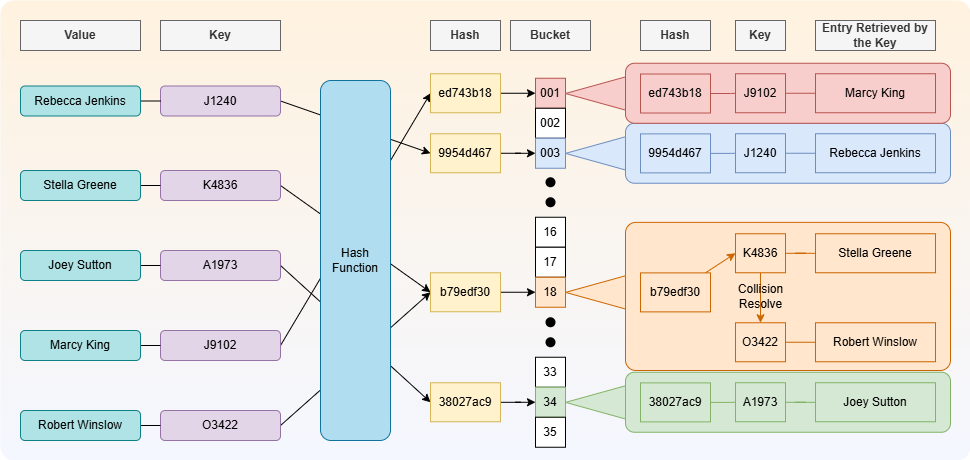
Keys: Unlike in JSON, a key can be of any 4GL primitive data type.
Bucket Value: Data are stored in the HashMap bucket, which can be of a primitive data type, structured, or a complex one. You can even nest HashMaps in the HashMap bucket.
Syntax
HASHMAP [OF data-type]
data-type can be a data type, a record definition, a user-defined type, a built-in class, an imported package class, or a Java class.
Defining HASHMAP
DEFINE ht HASHMAP -- is equal to HASHMAP OF VARIANT
DEFINE ht_string HASHMAP OF STRING
DEFINE ht_rec HASHMAP OF RECORD i INT, s STRING END RECORD
|
Method Name |
Description |
|
Returns the number of elements in a hash table. |
|
|
Returns a DYNAMIC ARRAY of all keys in the HashMap. |
|
|
Deletes an element with index. Returns TRUE If the operation is successfully performed, otherwise, it returns FALSE. |
|
|
Deletes all elements from the first to last. Returns TRUE If the operation is successfully performed, otherwise, it returns FALSE. |
|
|
Removes an element with the "key" key. Returns TRUE If the operation is successfully performed, otherwise, it returns FALSE. |
|
|
Inserts an element with a defined key and value. It fails if the key already exists. Returns TRUE If the operation is successfully performed, otherwise, it returns FALSE. |
|
|
Inserts or updates an element with a defined key and value. |
|
|
Removes all elements from hash table. Returns TRUE If the operation is successfully performed, otherwise, it returns FALSE. |
|
|
Appends an element from “ht” hash table. |
|
|
Returns an element with the “key” key. |
|
|
Returns a key of an element by index. |
|
|
Returns a value of an element by index. |
|
|
Sorts HashMap by key. "direction" > or = 1 - performs the sorting in the ascending order; "direction" < 1 -performs the sorting in the descending order. "direction" is an optional parameter that is equal to 1 by default. Any further operation that modifies data (like Insert, Remove, etc.) will remove the current sorting. |
|
|
Sorts HashMap by value. "direction" > or = 1 - performs the sorting in the ascending order; "direction" < 1 -performs the sorting in the descending order. "direction" is an optional parameter that is equal to 1 by default. Any further operation that modifies data (like Insert, Remove, etc.) will remove the current sorting. |
|
|
Sorts HashMap using the defined function. This is a binary function that accepts two elements of the HashMap. Any further operation that modifies data (like Insert, Remove, etc.) will remove the current sorting. |
|
|
Resets any sorting. |
|
|
Copies all elements of the HashMap into another HashMap. |
|
|
Returns TRUE if data with the defined key exists, otherwise, it returns FALSE. |
|
|
Returns TRUE if data with the defined value exists, otherwise, it returns FALSE. |
Element Keys
Elements are identified by a key in HashMap. Similar to a JSON object or an array index, a key allows access to the element it references. A key can be any type that can be converted to a string. Keys must be unique.
Keys are used in HashMap subscripts. The key value must be enclosed in square brackets:
DEFINE ht HASHMAP
LET ht["key1"] = "value1"
DISPLAY ht["key1"]
HashMap variable is passed to function only by reference and not by value. Thus, any changes in function will be applied to a variable from the calling function.
HashMap can be interacted with by INPUT ARRAY or DISPLAY ARRAY. In this case, HashMap is interpreted as:
DYNAMIC ARRAY OF RECORD
key VARIANT,
value <defined-data-type>
END RECORD
Built-in actions INSERT, DELETE, APPEND and UPDATE are prohibited in INPUT/DISPLAY ARRAY with a HashMap variable. But you can modify this variable by defining appropriate custom actions like in the code example below:
MAIN
  DEFINE hm HASHMAP

  LET hm["field1"] = "val1"
  LET hm["field3"] = "val3"
  LET hm[9] = "val9"

  CALL func(hm)

  DISPLAY "hm[10] = ", hm[10]
  CALL hm.remove(10)

  OPEN FORM f1 FROM "hashmap"
  DISPLAY FORM f1

  INPUT ARRAY hm WITHOUT DEFAULTS FROM inp.*
    ON ACTION "modify"
      LET hm["field2"] = "val2"
    ON ACTION "delete"
      CALL hm.remove("field1")
  END INPUT

  DISPLAY ht
END MAIN

FUNCTION func(hm)
  DEFINE hm HASHMAP
  DISPLAY "hm[9] = ", hm[9]
  CALL hm.remove(9)
  LET hm[10] = "val10"
END FUNCTION
hashmap.fm2 form:
<?xml version="1.0" encoding="UTF-8"?>
<form xmlns="http://namespaces.querix.com/2015/fglForms" title="New Form 1">
<form.rootContainer>
<CoordPanel identifier="rootContainer" visible="true" preferredSize="791,564">
<Table location="16,66" preferredSize="280,88" visible="true" enable="true" fieldTable="formonly" identifier="inp">
<TableColumn text="key" resizable="true" allowNewlines="true" visible="true" enable="true" fieldTable="formonly" identifier="">
<TextField dataType="Char,,,," visible="true" enable="true" fieldTable="formonly" identifier="f1"/>
</TableColumn>
<TableColumn text="value" resizable="true" allowNewlines="true" visible="true" enable="true" fieldTable="formonly" identifier="">
<TextField dataType="Char,,,," visible="true" enable="true" fieldTable="formonly" identifier="f2"/>
</TableColumn>
</Table>
</CoordPanel>
</form.rootContainer>
<form.screenRecords>
<ScreenRecord identifier="inp" fields="f1,f2"/>
</form.screenRecords>
</form>
Sorting HashMap:
DEFINE hashmap_value TYPE AS
    RECORD
      f1 INT,
      f2 STRING
    END RECORD


MAIN
  DEFINE hm HASHMAP OF hashmap_value

  LET hm["key_1"].f1 = 5
  LET hm["key_1"].f2 = "str1"
  LET hm["key_2"].f1 = 2
  LET hm["key_2"].f2 = "str2"
  LET hm["key_3"].f1 = 9
  LET hm["key_3"].f2 = "str3"

  DISPLAY "Sorting by key:"
  CALL DisplayHashmap(hm)

  DISPLAY "\nSorting by value Asc:"
  CALL hm.ValueSort(1)
  CALL DisplayHashmap(hm)

  DISPLAY "\nSorting by value Desc:"
  CALL hm.ValueSort(0)
  CALL DisplayHashmap(hm)

  DISPLAY "\nSorting Asc by 'f2' field using function CompareAsc:"
  CALL hm.CustomSort("CompareAsc")
  CALL DisplayHashmap(hm)

  DISPLAY "\nSorting Asc by 'f2' field using function CompareDesc:"
  CALL hm.CustomSort("CompareDesc")
  CALL DisplayHashmap(hm)
END MAIN

FUNCTION DisplayHashmap(hm)
  DEFINE hm HASHMAP
  DEFINE i INT
  FOR i = 1 TO hm.GetLength()
    DISPLAY "'", hm.GetKey(i), "' - '", hm.GetValue(i), "'"
  END FOR
END FUNCTION

FUNCTION CompareAsc(a, b)
  DEFINE a, b RECORD key REFERENCE, val dict_value END RECORD
  RETURN a.val.f2 < b.val.f2
END FUNCTION

FUNCTION CompareDesc(a, b)
  DEFINE a, b RECORD key REFERENCE, val dict_value END RECORD
  RETURN a.val.f2 >= b.val.f2
END FUNCTION
 Related articles