Lycia Configuration
Lycia Development Suite is highly configurable and can be customized to adopt your existing development and / or production infrastructure.
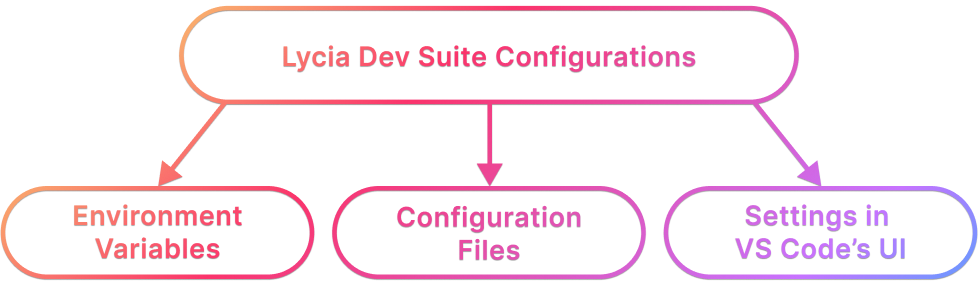
It has a wide variety of settings that come in three forms:
- configuration files;
- environment variables;
- settings provided in VS Code's UI.
Page contents:
► Lycia Configurations: Where To Start?
► Lycia Configuration By the Scope
Lycia Configurations: Where To Start?
There are several approaches you can take depending on the specific need:
| Route | Assumed Lycia Expertise | Take This Route If... | Quick Links | |
|
1 |
Quickstart Guide (Basic Settings) |
New User / Beginner |
...you need a step-by-step instruction for getting your applications running on baseline settings. Note: After you've set up your first project, you may need to return to this page for more broad configuration and customization of your projects and applications (for example, to Route 2 below).
|
|
|
2 |
Lycia Configuration By the Scope |
New User / Beginner |
...you want to learn Lycia configurations from the perspective of Lycia components. Note: We strongly recommend using the information from the Settings Priority section of this page in process of configuring your Lycia instance.
|
|
|
3 |
How-To Guides |
New User / Beginner |
...you have a specific request in mind and you require a practical solution. |
|
|
4 |
Reference |
Some Lycia Experience |
...you need to look up a particular Lycia feature for details. |
|
|
5 |
Deep Dive |
Some Lycia Experience |
...you'd like to have a full and in-depth understanding of the entire system of Lycia configurations. The sub-chapters for this approach are:
|
|
Lycia Configuration By the Scope
This approach aims to introduce all the range of Lycia configurations by the area of their influence (Lycia components) so that you can navigate Lycia configurations by a specific purpose. Moving to each scope's respective page, you'll find links to:
- Quickstart chapters for each particular scope;
- Reference pages;
- How-To guides;
- Links for documentation about environment variables that are used for that scope;
- Configuration files specifically for that scope.
|
|
|
|
|
Settings Priority
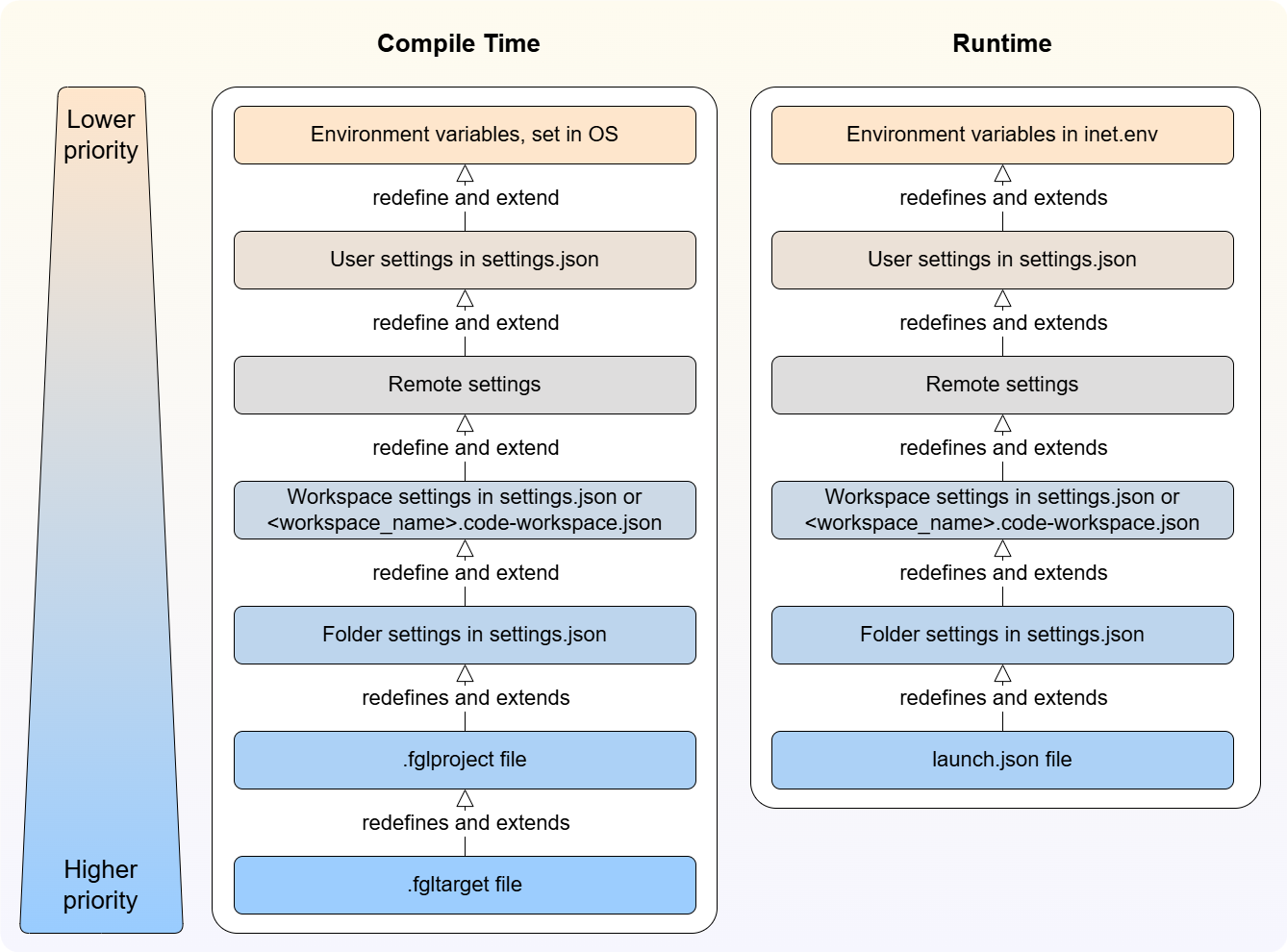
Lycia configurations can override each other. To eliminate possible configurations conflicts, learn the scheme provided below.
For compile time, the priority is the following (from lowest to highest): Environment variables, set in OS < User settings in settings.json < Remote settings < Workspace settings < Folder settings in settings.json < settings in .fglproject file < settings in .fgltarget file.
For runtime, the priority is the following (from lowest to highest): Environment variables, set in inet.env < User settings in settings.json < Remote settings < Workspace settings < Folder settings in settings.json < settings in launch.json file.
See also: Settings Precedence (VS Code documentation).
Example Configuration Scenarios
There is no universal Lycia configuration: what you configure, depends on your development and production purposes.
Here are some general situations for which you might need to configure your Lycia:
 connecting to databases
To connect to a single database, you need to
create these files: inet.env
set these variables: LYCIA_DB_DRIVER, CLIENT_LOCALE, DB_LOCALE + database-specific environment variables
For example, to connect to an Informix database, you must set these environment variables in inet.env:
LOGNAME =
INFORMIXPASS =
LYCIA_DB_DRIVER = informix
INFORMIXDIR = C:\Program Files\IBM Informix Client SDK
INFORMIXSERVER = querix_tcp
CLIENT_LOCALE = en_us.UTF8
DB_LOCALE = en_us.UTF8
To connect to multiple databases, you need to
create these files: database.cfg
You can read about database connection in this online documentation:
- about Informix connection
- about Oracle connection
- about SQL Server connection
custom compilation environment
You need to use these files: environ.bat (for command line-based compilation) or settings.json (LVSCE, for a particular scope as recognized by VS Code) or .fglproject (for settings influencing the project).
set these variables: any environment variables required by your program, e.g., CLASSPATH for importing your custom java classes to your 4gl program, etc.
custom runtime environment
You need to create these files: inet.env
set these variables: any environment variables required by your program, e.g., DBCENTURY, LINES and COLUMNS, QX_MENU_WINDOW, QX_COMPAT, and others
working with public client-side resources
You need to create this file: public.xml
working with custom application server instances
You need to
create these files: listener.xml
debugging
You need to
create these files: inet.env
set these variables: QXDEBUG, LYCIA_POST_MORTEM_LENGTH, LYCIA_SEVERITY, and others
specifying the location of the resources
In case you get a message that a file file_name can not be found, do the following:
1. Search for the file to find the location;
2. Check whether the location is defined in the PATH in Lycia environment files;
3. If you still get the error, check whether the user of Lycia has the permission to access the file. Grant access rights if required.
Here are some of the variables that control the location of the resources:
| Environment Variable | Purpose |
| FGLIMAGEPATH | Specifies the paths to search for images, theme files, styles, and scripts used by front-end functions. |
| LD_LIBRARY_PATH | Specifies the paths to search for shared libraries on UNIX platforms. |
| FGLLDPATH | Specifies the paths to search for C extensions and 4GL libraries. |
| DBPATH | Determines paths to search for the resource files. |
| LYCIA_MSGPATH | Specifies the path to search for 4GL message files. |
| FGLDBPATH | Specifies the paths for directories that contain the DB-Schema files. |
| FGLSOURCEPATH | Used for debugging in Lycia VS Code Extension (LVSCE) when there's a need to specify the paths to the source files. |
Deep Dive
- Environment variables influencing runtime appearance and behavior
- Database environment variables
- Environment variables that specify the location of configuration files
- Environment variables that specify the location of resources and libraries
- Environment variables used for debugging
- Informative environment variables
Configurations in the VS Code's UI
- Set Environment Variables for Projects and Programs
- Web Server Configurations
- Internationalization and Localization in Lycia